Real Labor vs. False Labor: How to Know If You’re Really in Labor
You feel it.
Your belly suddenly gets tight, you stop what you’re doing, and immediately your brain goes:
Wait…was that a contraction?
Then it happens again.
And now you’re looking at the clock, touching your belly and wondering the question almost every first-time mom asks toward the end of pregnancy:
“Is this actually labor, or is my body playing with me again?”
Mama, if you’ve been trying to figure out real labor vs. false labor, you are definitely not the only one.
One of the biggest misconceptions about labor is that you’ll automatically “just know” when it starts. Sometimes you will. But especially with your first baby, the beginning of labor can be surprisingly confusing.
Braxton Hicks contractions can feel convincing. Early labor can start slowly. Contractions may be mild at first. And your body can do a whole lot of warming up before the main event actually begins.
So instead of depending on one contraction to tell you what’s happening, I want you to learn how to recognize the pattern.
Because one contraction doesn't tell us much.
What happens over the next several contractions tells us a whole lot more.
What Is False Labor?
When people talk about “false labor,” they're usually talking about Braxton Hicks contractions, sometimes called practice contractions.
These are uterine contractions that can happen before true labor begins. They are usually less regular than true labor contractions and don't progressively become stronger and closer together in the same way. They may also ease when you rest, walk, change positions or otherwise change what you're doing.
But I want to clear something up right away.
False labor does not mean fake.
You really are feeling your uterus contract.
And Braxton Hicks contractions aren't always completely painless. Some women barely notice them. Others find them uncomfortable or even painful. That's one reason trying to decide whether you're in labor based only on how much a contraction hurts can get confusing.
Instead, watch what the contractions do over time.
Braxton Hicks contractions often don't develop a consistent rhythm. You might have one contraction, another seven minutes later, another twelve minutes later and then nothing for twenty minutes.
They may settle down when you rest or change your activity.
That's why I like to tell my mamas:
False labor tends to back down when you do.
Not every time. And it isn't a diagnostic test. But it can be a helpful clue.
What Does Real Labor Feel Like?
Real labor is different because the contractions begin developing a pattern and progressing.
True labor contractions tend to become regular, get closer together, last longer and become more intense over time. They also generally continue despite changing position, resting or moving around.
And this is where I want you to stop asking:
“Did that hurt enough to be labor?”
And start asking:
“What are these contractions doing?”
That little mindset change can make the beginning of labor much less confusing.
There are three things I especially want you watching.
Sign #1: Your Contractions Develop a Pattern
One random tightening?
Probably not enough information.
Several contractions that continue coming?
Now we're paying attention.
With real labor, contractions tend to become increasingly regular instead of remaining completely unpredictable. The time from the beginning of one contraction to the beginning of the next gradually becomes more consistent and often shorter as labor progresses.
Imagine your contractions start like this:
Ten minutes apart.
Then nine.
Then eight.
Then seven.
And while this is happening, they're continuing instead of disappearing.
That's very different from:
Eight minutes.
Fifteen minutes.
Six minutes.
Twenty-three minutes.
Then nothing for an hour.
The first pattern makes me much more interested in what your body is doing.
And this is why timing contractions can be so helpful once you think labor may be starting.
You don't necessarily need to obsessively time every tightening you've felt for the last three weeks of pregnancy. But once contractions seem to be developing a pattern, start paying attention to when each one begins, how long it lasts and how far apart they are.
You're looking for progression, not perfection.
Sign #2: Your Contractions Become Longer and Stronger
Early labor contractions don't necessarily begin with movie-scene intensity.
For many women, things start much more quietly.
You may initially be able to talk through contractions, walk around, watch television or wonder whether they're even real.
Then something begins to change.
The contractions start requiring more of your attention.
They're lasting longer.
They're becoming harder to ignore.
You may notice yourself becoming quieter when one begins.
You have to stop and breathe.
Eventually, having a normal conversation during a contraction becomes harder.
True labor contractions typically become longer and more intense as labor progresses. MedlinePlus describes true labor contractions as commonly lasting around 30 to 70 seconds and growing stronger with time, although your individual labor pattern can vary.
So again, don't get stuck asking whether one contraction was “painful enough.”
Look at the trend.
Are they building?
That matters more.
Sign #3: They Keep Coming Even When You Change What You're Doing
Here's one of the most useful differences between Braxton Hicks and real labor contractions.
Try changing what you're doing.
If you've been active, sit or lie down.
If you've been sitting for a long time, move around.
Drink some water.
Empty your bladder.
Get comfortable.
Then watch.
Braxton Hicks contractions may ease or stop after rest, movement or a change in position. True labor contractions are more likely to continue despite those changes.
In other words:
Real labor doesn't care that you got comfortable.
Those contractions keep showing up.
And over time, they're usually becoming more organized rather than less organized.
That's when I want your antennas going up.
Braxton Hicks vs. Real Labor: The Quick Comparison
| Braxton Hicks / False Labor | Real Labor |
|---|---|
| Often irregular | Develops a more regular pattern |
| May stay about the same intensity | Usually becomes stronger |
| May ease with rest or position changes | Continues despite changing activity |
| May stop altogether | Keeps progressing |
| Doesn't cause the progressive cervical changes of true labor | Contractions are associated with cervical change |
Your provider may need to assess your cervix to know for certain whether labor has begun. Sometimes contractions alone cannot give you a definite answer.
That's important because I don't want you thinking there's some magical at-home test that guarantees you're in labor.
We're looking for signs.
Your medical team determines what's actually happening clinically.
What About Back Pain and Lower Belly Pressure?
You may have heard that “real contractions start in your back.”
Sometimes they do.
But please don't wait for back labor before believing you're in labor.
True labor can include pain or pressure in the abdomen and lower back, and contractions may radiate through those areas.
Every labor doesn't feel exactly the same.
Some women describe intense menstrual-like cramping.
Some feel tightening across the entire abdomen.
Some notice significant back pressure.
Some feel a combination.
That's why location alone isn't the best way to determine whether you're in labor.
Once again, we're coming back to the pattern:
Are the contractions becoming regular?
Are they continuing?
Are they getting longer or stronger?
Are they moving closer together?
That's the information you want.
“Okay Stephanie, I Think This Is Real Labor. What Do I Do Now?”
This is exactly where I see first-time moms freeze.
Because figuring out whether labor is real is only the first decision.
Then suddenly you have twelve more.
Do I call the hospital now?
Do I take a shower?
Should I eat?
When do I wake my partner?
How long should I stay home?
When do we grab the hospital bag?
What if my water breaks?
What if the contractions suddenly get stronger?
And this is why I tell moms that knowing about labor isn't necessarily the same thing as knowing what to do when labor starts.
You don't want 2 a.m. to be the first time you try to put all the information together.
You want a plan before you need the plan.
When you're full term, your own obstetrician or midwife should give you specific instructions about when they want you to call and when they want you to come to your hospital or birth location. Different providers may give slightly different instructions depending on your pregnancy and circumstances.
If you think you're in labor and aren't sure what to do, call your healthcare provider.
Don't Ignore These Signs While Waiting for a Contraction Pattern
There are also times when I don't want you sitting at home trying to decide whether you've reached the “perfect” contraction pattern.
If you think your water has broken, contact your provider even if contractions haven't started yet. You should also contact your provider for vaginal bleeding beyond light spotting or if you notice decreased fetal movement.
And if you're less than 37 weeks pregnant, don't use full-term labor rules to decide whether you should wait.
Regular or frequent contractions, pelvic pressure, a persistent low backache, changes in vaginal discharge, abdominal cramping or leaking fluid before 37 weeks can be signs of preterm labor and should prompt a call to your healthcare provider.
When something feels wrong or different to you, you also don't need permission from a contraction timer to call your provider.
Can Braxton Hicks Turn Into Real Labor?
This is another question first-time moms ask all the time.
You may experience Braxton Hicks contractions for days or weeks before real labor begins. Eventually, true labor starts, but there isn't necessarily one dramatic moment where a Braxton Hicks contraction “turns into” a labor contraction.
Instead, you may notice that the pattern changes.
Yesterday your contractions disappeared after you rested.
Tonight they're still coming.
Earlier they were scattered.
Now there's rhythm.
At first you barely paid attention.
Now you have to stop what you're doing when one begins.
That's why recognizing progression is so useful.
Your body doesn't have to send you a giant flashing sign that says:
LABOR HAS OFFICIALLY STARTED.
Sometimes your biggest clue is simply that the contractions aren't going away anymore.
How Long Should I Time Contractions?
If your contractions are mild and inconsistent, you don't have to spend the entire evening staring at an app.
Give yourself permission to observe.
Rest.
Hydrate.
Eat if you're able and haven't been told otherwise by your healthcare team.
Keep your environment calm.
Once you notice a consistent pattern developing, begin timing from the start of one contraction to the start of the next and record how long each contraction lasts. That is the method recommended when tracking contractions to help distinguish true from false labor.
And remember: your goal isn't winning a contraction-timing contest.
Your goal is collecting enough information to understand what your body appears to be doing and communicate that information to your care team.
How Can You Know for Sure That You're in Labor?
This may be the most important thing in this entire article:
You cannot always know for sure at home.
True labor involves regular contractions that cause changes to the cervix. Your provider may need to evaluate your cervical changes to confirm that labor is actually progressing.
So please don't beat yourself up if you go to the hospital and discover you're not as far along as you thought.
You didn't “fail.”
You learned what your body was doing.
And you can use that information going forward.
My goal isn't to make you afraid of going to the hospital too early.
It's to make sure you understand your body well enough that every tightening doesn't automatically send you into panic mode.
There's a difference.
The Real Goal Isn't Just Recognizing Labor
Knowing real labor vs. false labor is step one.
But I want you prepared for step two.
And step three.
Because once you realize, “Okay…this is really happening,” that's when you need to know what to do next.
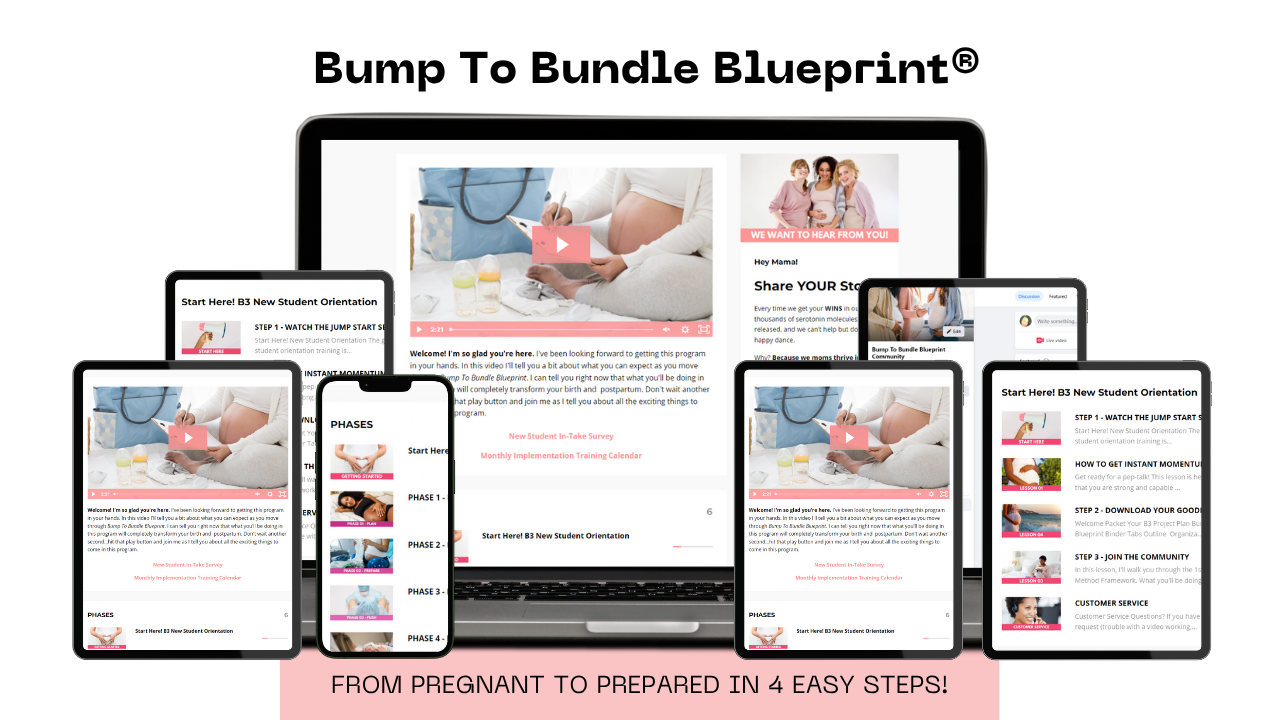
That's exactly why I created Bump To Bundle Blueprint.
I walk you step by step from:
“Wait…is this labor?”
all the way through meeting your sweet baby.
We talk about what happens during labor, comfort measures, your options, communicating with your birth team, preparing your partner, birth planning, pushing and what comes immediately after birth.
Because my goal isn't for you to collect more pregnancy information.
I want you to be able to use what you know when the moment actually comes.
No frantic Googling.
No trying to remember seventeen Instagram reels between contractions.
No looking at your partner and both of you realizing neither one of you knows what you're supposed to do next.
You've already learned it.
You've practiced it.
Now you're simply following your plan.
And if you're not ready for the full course yet, come join me inside Due Date Diaries. I'll keep helping you prepare week by week so you don't walk into labor wondering what everyone forgot to tell you.
Because mama, you don't have to know exactly what your labor will look like.
Nobody can promise you that.
But you can walk into it understanding what's happening, knowing your options and feeling prepared for what comes next.
And that makes a huge difference.
Happy birthing, mama!
DISCLAIMER:
This article is for general childbirth education and is not a substitute for individualized medical advice. Follow the instructions provided by your obstetrician, midwife or maternity care team.

Hi! I'm Stephanie!
Stephanie Poole
Creator, Bump To Bundle Blueprint®
Most women struggle with preparing for birth. So, I created an academy that helps new moms prepare for their FIRST hospital birth. Birth Prep Academy helps Mamas (like you) transition into motherhood...Like A Boss!
Bump To Bundle Blueprint®
If you think you need help preparing for your birth...you do! Prepare for your first birth faster than you can say:

